
What Page County Property Tax Records Show
The county's real-estate page shows the assessment side of Page County property tax records: owner name, address, parcel description, deed-book reference, dimensions, buildings, acreage, and fair-market value for land and buildings. The Treasurer's Real Estate Public Inquiry is a separate path. It covers tax bills and payment history instead. Keep those two record sets distinct and the lookup gets much easier.
| Field | What It Shows | Where |
|---|---|---|
| Land and building value | Fair-market valuation categories described by the county | Commissioner of the Revenue |
| Parcel description | Name, address, dimensions, buildings, acreage, and deed reference | Property card / real-estate record |
| Tax account | Bill and payment history by name, account, parcel, or street | Treasurer inquiry |
| Ticket detail | Details for a selected tax payment ticket | Treasurer inquiry |
| Relief programs | Program information; eligibility details require office confirmation | Commissioner of the Revenue |
An assessment value and a tax bill answer different questions. The value reflects the county's valuation of land and buildings. The bill and payment screens show account activity instead. Remember that a payment history is not a title record. The amount paid is also not the price at which a parcel sold.
Page County Property Tax Records Follow a Four-Year Reassessment Cycle
Page County reassesses general values every four years unless the Board of Supervisors decides otherwise. New parcels and buildings get picked up through courthouse transfers and building-permit information. A deed date can land in one system. A construction approval can land in another. An assessment change may follow later. When checking a recent sale against the assessment, compare the recorded deed with the current card. Do not assume the assessment equals the latest sale price. The county publishes no stated refresh lag. Ask the Commissioner of the Revenue how a particular card was updated. The public page lists fair-market valuation for land and buildings. That number is not a private appraisal. The county does not present it as one.
The county real-estate page states the reassessment cycle and the public property-field categories.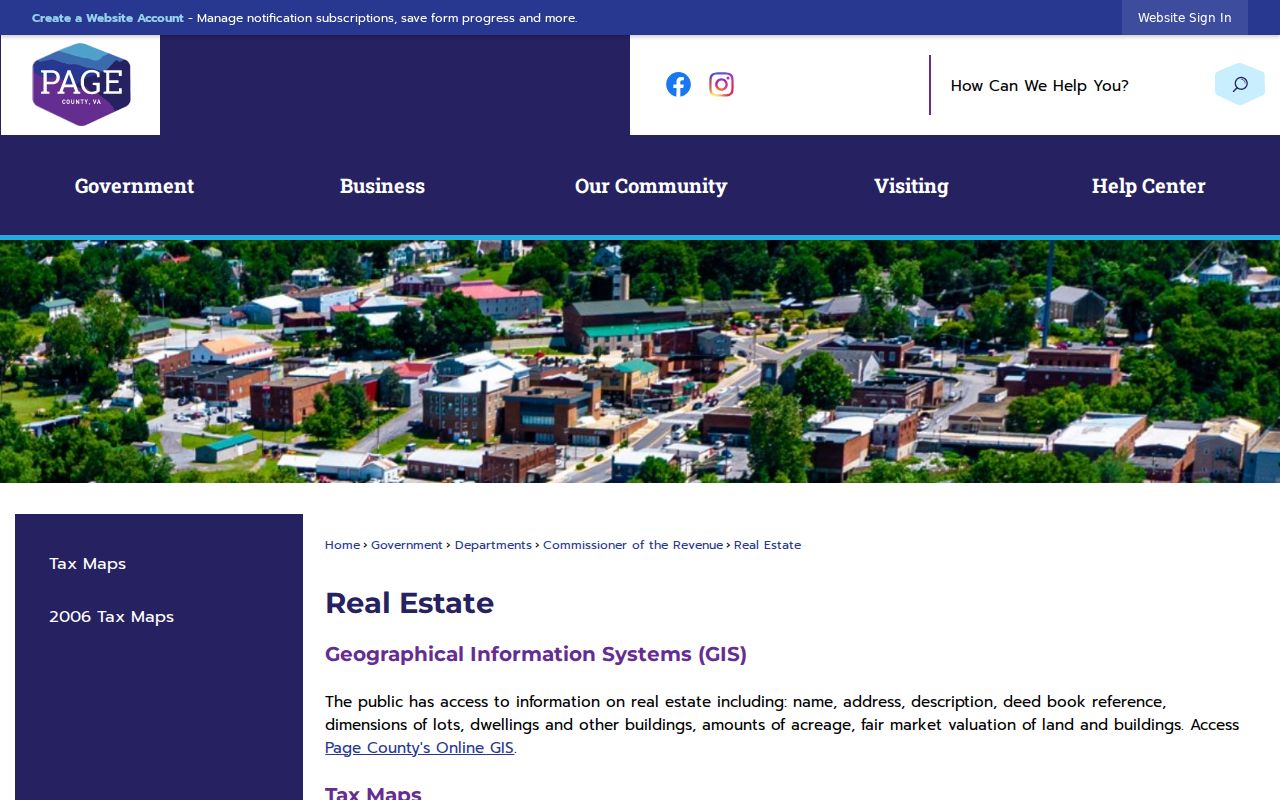
The official guide is the source for the county's assessment fields and general cycle.
Search Fields in Page County Property Tax Records
The Real Estate Public Inquiry separates the search key from the account history that follows. Pick the mode matching what you already know. Keep the optional projected date out of the record itself, since it exists only to calculate penalty and interest.
| Mode | Fields | What follows |
|---|---|---|
| Name | Last Name and First Name; optional Projected Date | Name Selection, then account history |
| Account | Taxpayer Account Number; optional Projected Date | Payment History |
| Parcel | Parcel Number; optional Projected Date | Payment History |
| Street | Street Name only; no house number | Matching tax accounts along the street |
Inside Payment History, Select opens Ticket Detail and Previous returns to the prior screen. The exact bill fields, current-year availability, delinquency cutoffs, processor charges, and any tax-sale list are not published there. Confirm those items with the Treasurer. Portal help screens are not a complete account statement.
Open the Real Estate Public Inquiry help page for these documented search modes.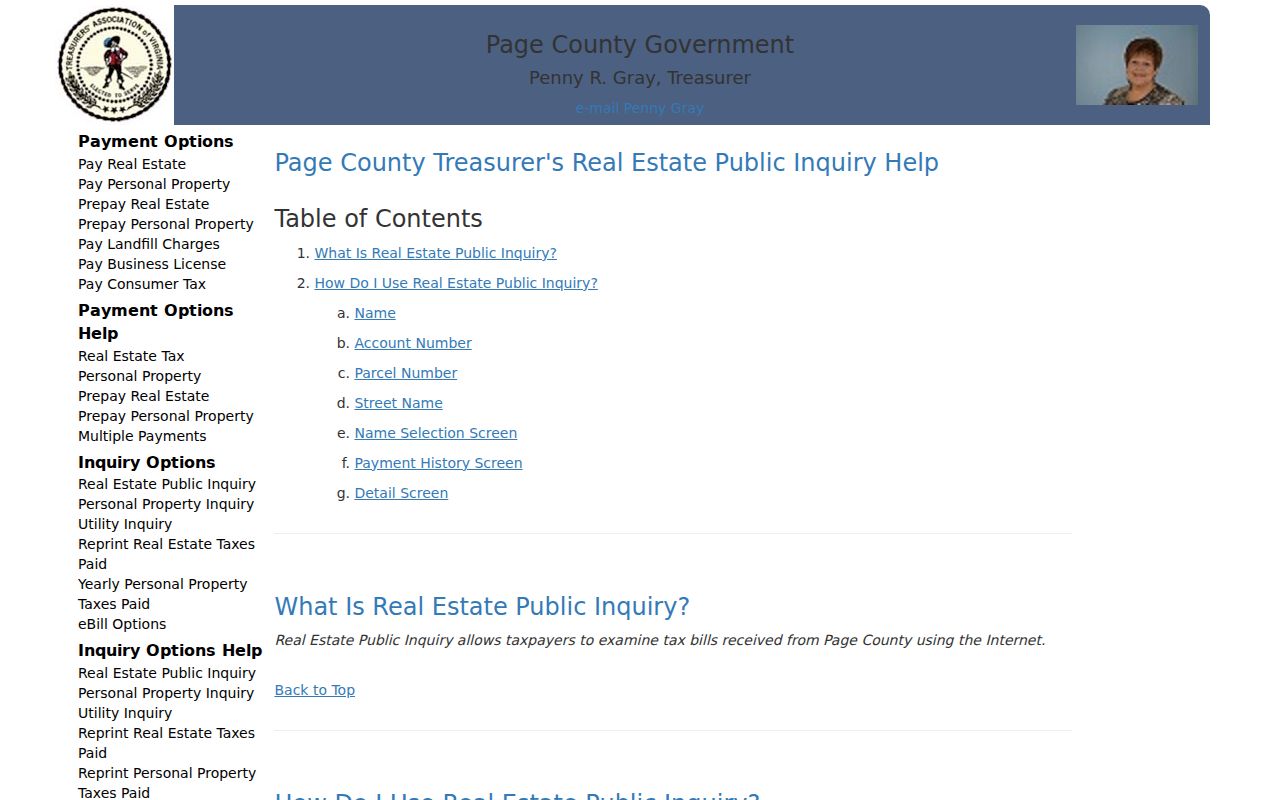
The official help page lays out the full sequence, from an initial search through to a selected payment ticket.
Look Up a Page County Property Tax Record
The question may be whether a tax account has bills or recorded payments. Use the Treasurer inquiry for that. Search by parcel or account when you hold the number. Search by name when the taxpayer is known. Use street name to see every tax account on a road. The optional projected date is a calculation aid only. It is not an official due-date record. For delinquency status or a tax-sale matter, ask the Treasurer for the account's current position.
- Choose Name, Account Number, Parcel Number, or Street Name in Real Estate Public Inquiry.
- Enter the search key; for Street Name, do not enter the house number.
- Use Select to open matching account history and then Ticket Detail for a chosen payment.
- Confirm current balances, delinquency, or sale status with the Treasurer because the portal's full cutoff rules were not verified.
- Assessment
- The county's valuation record for land and buildings.
- Tax account
- The Treasurer's bill and payment-history record tied to a taxpayer or parcel.
- Projected Date
- An optional input used to calculate penalty and interest in the inquiry.
- Tax lien
- A claim that should be checked in the appropriate land or court records as well as with the Treasurer.
Page County Property Tax Records and Relief Programs
The Commissioner of the Revenue identifies land-use and tax-relief programs among its responsibilities. These include elderly and veterans relief. Current application forms, income limits, filing dates, and eligibility rules are not published in detail. A generic program description cannot tell you that a parcel or owner qualifies. Contact the office for current program details and ask which records the specific property needs. The listed real-estate and land-use/tax-relief phone is 540-743-4909. Keep program questions separate from the Treasurer's payment history. The Commissioner handles assessment and relief; the Treasurer inquiry shows bills and payments. A relief award can change what is due. It does not touch the recorded deed or the land description. For ownership, use the Circuit Court deed. For the tax-account result, use the Treasurer.
The Commissioner of the Revenue page lists the office and its program responsibilities.Check Page County Property Tax Records for Sale Status
The public inquiry shows payment history and ticket detail. But it publishes no complete tax-sale docket, sale-list URL, delinquency cutoff, or auction calendar. A payment screen alone cannot tell you whether a legal action or sale notice exists. It also cannot show a redemption period or later deed. Ask the Treasurer for the current balance and status. Then check Circuit Court land records for any recorded tax deed or related instrument. A sale notice or historical list may not be posted. In that case, file a specific Virginia FOIA request naming the record type and date range. Page County's online public-record form states a five-working-day response window. Statutory extensions and cost estimates can still apply. Never pay through an unsolicited link. Do not assume a third-party notice is official, either. Reach the county through its published domain and request current payment instructions directly.
Verify the Page County Property Tax Assessment Review Process
Page County reassesses all property on a four-year general cycle. The Commissioner of the Revenue serves as the assessment office. The county offers no stable official source for the current appeal form. It also publishes no reliable listing of the review board's makeup, the evidence rules, or the filing deadline. Never borrow those details from another county's process. If a value looks wrong, contact the Commissioner. Ask for the written review steps, the deadline that applies to the parcel, and the documents the office wants. The public property description lists land and building values, dimensions, acreage, and improvements. Those fields help frame a focused question. Keep a copy of every record and letter.
To see how assessed value differs from sale price, compare the recorded deed with the valuation fields. An assessment is a tax record. It is not an appraisal of what the property would fetch on the market.
Page County Property Tax Assessment Review Steps
Page County publishes its general reassessment interval. It publishes no current appeal deadline or review-board procedure. Ask the Commissioner of the Revenue directly. That office can state the form, supporting material, and filing date that apply to the assessment notice at hand. Relying on another locality's calendar can cost a Page County parcel its entire appeal window.
Review steps. Ask the Commissioner for the current written appeal process and deadline. The available county sources establish a four-year general reassessment cycle but do not establish a filing date or board route.